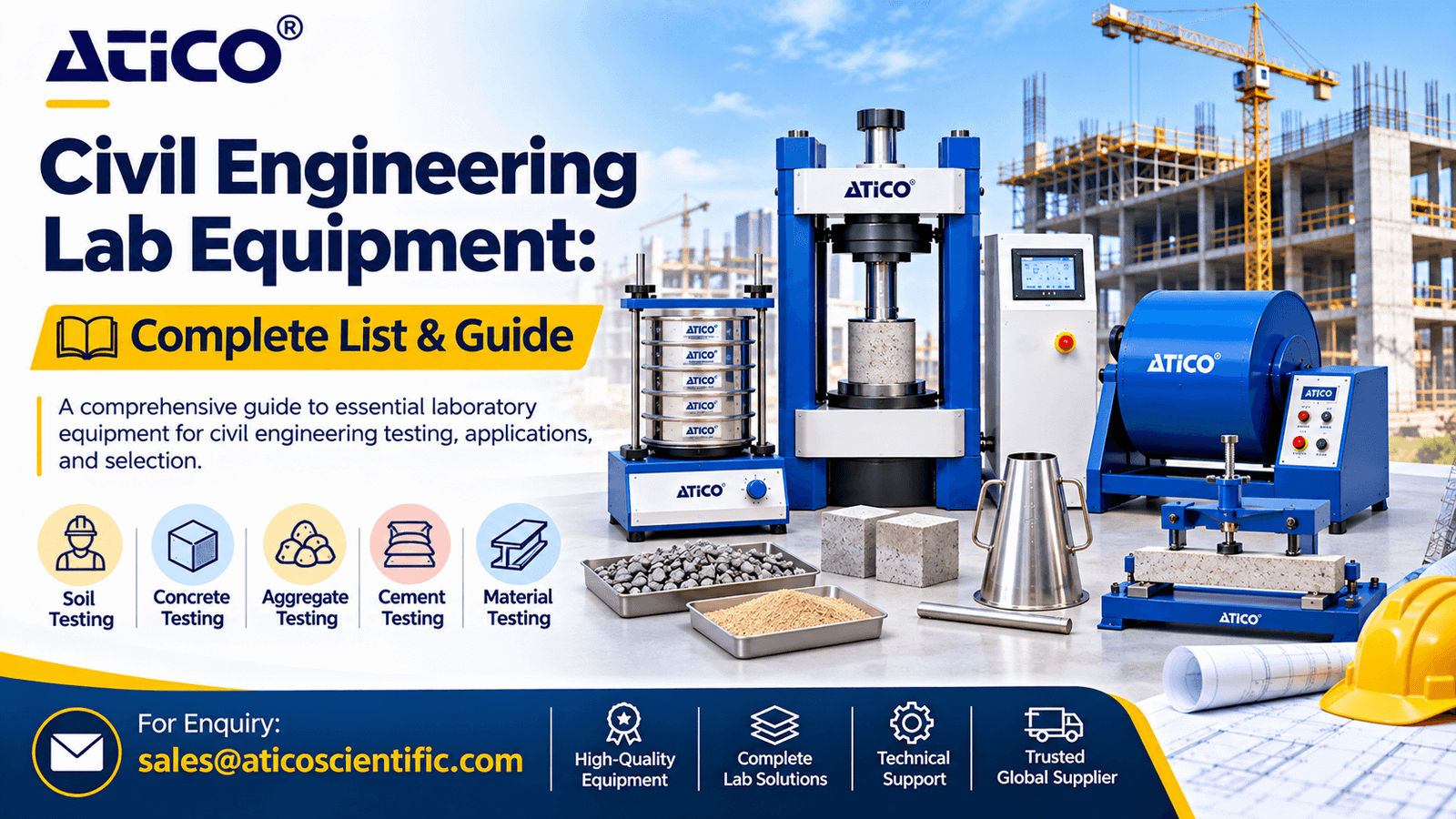
Even the best construction project can have trouble if the materials used do not comply to the specifications. Soil may not behave as expected when loaded; concrete may not develop adequate strength; aggregates may not be able to resist repeated traffic loads. That's why civil engineering lab is essential in building and the development of infrastructure.
At Atico Scientific, we manufacture and supply civil engineering laboratory equipment for engineering colleges, universities, construction companies, material testing laboratories, and research institutions. We offer a wide range of soil mechanics, cement, concrete, aggregates, bitumen and material testing services. This will guide you through the essential civil engineering lab equipment list, explain what each of these civil engineering lab equipment does and help you identify what lab equipment you need for your lab.
What Does a Civil Engineering Lab Test?
A lab in Civil Engineering is a place where the physical and mechanical properties of the materials used in construction are studied. The goal is to gain insight into the properties of these materials, without using them in any real project, prior to the actual project.
There are five broad categories of tests:
Soil testing: moisture content, soil density, compaction, permeability, shear strength and bearing capacity.
Cement testing: tests for consistency, setting time, soundness and other properties related to the performance of cement.
Concrete testing: measures workability, compressive strength, and flexural strength.
Aggregate Testing: Tests for particle size distribution, abrasion resistance, impact resistance and material quality.
Bitumen testing: Tests penetration, ductility and softening point for road construction applications.
These tests are also vital to practical education for engineering institutions. Students are taught how theoretical concepts like stress, strain, compaction and material strength are measured in actual laboratory conditions.
Soil Testing Equipment
Soil is the base of almost all civil engineering works. It has properties of strength, density and moisture that affect the design of foundations, making of roads as well as stability of earthworks. A geotechnical laboratory should be well equipped with instruments that are used to analyze these properties.
Tensile strength testing is performed using the CBR, Proctor Compaction, Triaxial, Shear, Consolidation, and Sieves methods.
These are crucial instruments in a civil laboratory equipment list:
California Bearing Ratio (CBR) Testing Machine:
This machine is used to test the strength of subgrade soil and pavement material. The results of the CBR test enable engineers to determine if the soil is suitable for use in road construction.
Proctor Compaction Apparatus:
It is used to determine the relationship between moisture content and dry density. It is used in compaction to determine the optimum moisture content and maximum dry density.
Triaxial Testing Equipment:
Used to test the shear strength of soils under controlled confining pressure and loading conditions. It is especially applicable to the study of foundation and slope stability.
Direct Shear Apparatus:
Used to measure the shear strength parameters of soil via the measurement of resistance of soil to sliding along a defined plane.
Consolidation Testing Apparatus:
Measures the compaction of soils under prolonged loading. The results enable engineers to estimate settlement of the foundation and other structures.
Soil Test Sieves:
These are used to do a particle-size distribution analysis and are used for classification of soil based on the relative amount of each size particle in the soil.
Soil testing range:
CBR apparatus, Proctor compaction equipment, direct shear machines, triaxial testing systems, consolidation equipment and soil sieves are all provided at Atico Scientific.
Cement & Concrete Testing Equipment
Cement and concrete are an important part of building construction, bridges, foundations and structural works. The properties should be assessed during various stages, from the fresh mix to hardened concrete testing.
The main instruments include:
A compression testing machine with moulds, Vicat, slump and flexure.
Compression Testing Machine:
This machine is used to determine the strength of concrete cubes or cylinders when a controlled load is applied until failure. One of the key tools in a concrete laboratory.
Concrete Cube and Cylinder Moulds:
These are used for making standard test specimen for strength testing. To get proper results, the dimensions must be accurate and the specimens must be properly prepared.
Vicat Apparatus:
It is used to find out the standard consistency and setting time of cement. It is used to evaluate the properties of cement when water is added.
Slump Test Apparatus:
Is used for determining consistency and workability of fresh concrete. The slump test in laboratory and field use of plastic concrete is detailed in ASTM C143/C143M.
Flexural testing machine:
Used to test the flexural strength of concrete beams under bending loads. This is beneficial when analyzing actual performance with bending stresses in applications.
The concrete testing range at Atico Scientific consists of concrete testing machines, cube molds, slump apparatus, concrete vibrating tables, concrete testing machines (flexural testing machines), and other concrete testing instruments.
Aggregate & Bitumen Testing Equipment
Aggregates and bitumen directly affect the performance of the pavement. The quality of their performance has an impact on pavement durability, wear resistance, and traffic and weather resistance of a pavement structure.
The following equipment should be available in a suitable lab:
Los Angeles Abrasion Testing Machine:
Measures the resistance of the aggregate to abrasion and impact by placing it in a machine and rotating it under controlled conditions with abrasive materials.
Aggregate Impact Value Apparatus:
Used to test the resistance of aggregate to sudden impact. It is useful for assessing suitability for road construction.
Bitumen Penetrometer:
It is used to measure the penetration of a standard needle into the bitumen under specified conditions, to help determine the consistency of bitumen.
Ductility Testing Machine:
Tests the elongation that bitumen can undergo before it fails under specified conditions.
Softening Point Apparatus: The softening point apparatus is used to determine the temperature at which a bitumen sample has a specified degree of softness, under standard test conditions.
They are used in road material laboratories to determine whether aggregates and bituminous materials satisfy the requirements of the applications to which they are being used.
Surveying & Material Testing Instruments
Soil and concrete testing are only two examples of civil engineering work. The correct measurement and dimensional testing, as well as mechanical testing, are equally crucial.
Here is a comprehensive civil engineering lab equipment list that a complete set of lab equipment for civil engineering might consist of:
Surveying instruments:
Surveying instruments that assist with angle measurement, elevation checks, distance measurement, and site surveying include theodolites, levels, and total stations.
Universal Testing Machine (UTM):
Tests tensile, compressive, and other mechanical properties of suitable specimens of material with appropriate fixtures.
Hardness Testing Machines:
Determine resistance to indentation or resistance to deformation, depending on the method of hardness testing.
Use of Impact Testing Machines:
Test the response of materials to sudden loading.
Tensile Testing Equipment:
Equipment used to assess the response of material when being stretched, such as its strength and elongation.
Atico Scientific is an eminent manufacturer of civil engineering lab equipment and manufactures civil and mechanical engineering laboratory instruments for educational, research, and material testing.
Built to standards (ASTM / IS / BS / EN)—why it matters
Purchasing equipment is just one piece of the puzzle to building a viable testing lab. Also, the equipment should be appropriate to the testing standards and procedures to be used by the laboratory.
ASTM, IS, BS and EN standards include the test methods, specimen preparation, dimensions, loading and reporting requirements. For example:
IS 2720: Methods of Soil Testing: covers various methods of soil testing such as compaction, shear strength and CBR related soil tests.
ASTM D1883: Specifies the laboratory CBR test for compacted soils.
ASTM C143/C143M: Specifies the slump test for plastic concrete.
ASTM C39/C39M: Specifies the compression strength of cylindrical concrete specimens.
EN standards: Offer European test and product specifications in various categories of construction materials.
It is not enough to just call a machine "suitable for all standards" to mean that every standard is covered. The configuration, accessories, dimensions, and operating range must be compatible with the test method. When requesting a quotation, Atico Scientific welcomes the customer's specific requirements to be included in the request, to allow the optimal equipment configuration to be discussed.
How to Choose a Civil Engineering Lab Equipment Manufacturer
The first step in making a good civil engineering lab equipment list purchase is to determine the role of the lab. The requirements for the teaching laboratory of an engineering college are widely varied, and a commercial testing establishment may require more testing capacity and repeatability.
Here are some factors to keep in mind before choosing a manufacturer:
Ensure product range:
Have a manufacturer who can provide support for a variety of product testing methods, such as soil, cement, concrete, aggregate, and bitumen.
Check technical specifications:
Check capacity, loading limit, size, accessories, controls, and power requirements.
Discuss applicable standards:
Discuss the relevant ASTM, IS, BS, or EN test methods prior to finalizing equipment.
Think about laboratory size:
Design equipment layout, work area, electrical supply, and specimen storage.
Evaluate manufacturing capability:
Look for established manufacturing facilities, quality checks, and product documentation.
Discuss project supply:
In case of a complete lab setup, discuss the equipment schedules, BOQs, packaging, and delivery requirements.
Since 1954, Atico Scientific has been producing scientific and engineering laboratory equipment. Our manufacturing & export office is situated at Ambala, Haryana, India, and our products are manufactured for institutions, universities, testing laboratories, research institutes, etc. Our civil engineering line includes all the equipment for soils, cements and concrete, aggregates, bitumen, and surveying, so customers can speak with one manufacturing source about several of their lab needs.
FAQ
What is the basic equipment used in a civil engineering lab?
The basic equipment for use typically consists of soil testing sieves, the Proctor compaction apparatus, the CBR apparatus, the cement testing apparatus, concrete cube molds, a compression testing machine, the slump test apparatus, and aggregate testing instruments. The final selection will be based on the curriculum or scope of testing at the laboratory.
What piece of equipment is crucial for soil testing?
Commonly used instruments include those such as CBR machines, Proctor compaction apparatus, direct shear equipment, triaxial testing systems, consolidation apparatus, and soil sieves.
What is the difference between a compression testing machine and a universal testing machine?
A compression testing machine is mainly used to test compressive strength. Depending on the type of test, the mechanical tests can be tensile, compression, and bending tests with different configurations and accessories of the universal testing machine.
Does Atico Scientific provide equipment for a complete civil engineering lab?
Yes. Atico Scientific provides equipment in categories of soil, cement, concrete, aggregate, bitumen, and surveying. When purchasing, customers have the option to provide their laboratory specifications and get a custom list of equipment and quotation.
Should civil engineering laboratory equipment comply with ASTM and IS?
Equipment should be appropriate for the types of test methods and standards the laboratory requires. Users are advised to verify the standard, machine configuration, and accessories prior to ordering.
Atico Scientific: Create Your Civil Engineering Lab with High-Quality Civil Engineering Lab Equipment
Every utensil plays a part in the effective understanding of the construction materials by the students, engineers, and technicians, from the soil mechanics teaching laboratory to the complete material testing facility. Manufacturing experience and a wide selection of engineering equipment are combined to enable institutions to plan the requirements of their laboratory with greater clarity at Atico Scientific.
From individual testing machines to a coordinated civil lab equipment setup, we can assist you in finding the appropriate product to fit your application.
Provide Atico Scientific with your civil laboratory equipment list, required testing standards, and project details to discuss product specifications and get a quotation.
0 Replies to “Methods of the recruitment”